Hermes
Hermes, the divine messenger of the Olympian gods, appears in the Odyssey as the executor of Zeus's decrees, a guide for the living and the dead, and a figure whose interventions—whether delivering commands to Calypso, warning Aegisthus, or arming Odysseus against Circe's magic—set the poem's most crucial plot turns in motion. He is the god who bridges the mortal and immortal realms, the one who seals men's eyes in sleep or wakes them, and the only deity who descends into the underworld to lead the souls of the slain suitors to their final rest. His role is that of a catalyst: he does not fight or scheme, but his appearances mark the moments when divine will becomes irreversible action.
Identity and Attributes
Hermes is consistently identified as the messenger of Zeus, the "guide and guardian, slayer of Argus." He is equipped with the golden wand with which he seals men's eyes in sleep or wakes them just as he pleases, and he wears glittering golden sandals that allow him to fly like the wind over land and sea. His speed is emphasized: he skims the waves like a cormorant, flying over many a weary wave to reach the island of Ogygia. He is also the god who escorts the dead to the underworld, a function he performs at the end of the poem when he summons the ghosts of the suitors and leads them, whining and gibbering, down into the dark abode of death. The wand he carries is the same instrument he uses for this task, and he is described as "the healer of sorrow" as he guides the souls past the waters of Oceanus and the rock Leucas to the meadow of asphodel.
Divine Missions and Interventions
Hermes's most consequential mission in the Odyssey is his journey to Ogygia to deliver Zeus's command to Calypso. Zeus sends him to tell the nymph that the gods have decreed Odysseus must return home, and that he is to be convoyed neither by gods nor men but must sail on a raft to Scheria. Hermes finds Calypso at home, singing beautifully at her loom in a cave surrounded by a lush wood of alder, poplar, and cypress, with four running rills irrigating beds of violets. He delivers the message bluntly: "Jove sent me; it was no doing of mine." Calypso trembles with rage at the command, accusing the gods of jealousy, but she cannot cross Zeus, and Hermes departs after telling her to send Odysseus away or face Zeus's anger. This mission directly enables Odysseus's departure from Ogygia and the entire second half of his journey.
Earlier in the poem, Hermes is sent by Zeus to warn Aegisthus not to murder Agamemnon nor to woo Clytemnestra, telling him that Orestes would take revenge when he grew up. Zeus recounts this in the first divine council, noting that Hermes spoke "in all good will" but that Aegisthus would not listen, and now has paid for everything in full. This warning, though unheeded, establishes the moral framework of the poem: the gods give clear warnings, and mortals who ignore them bring destruction upon themselves.
The Encounter with Odysseus on Aeaea
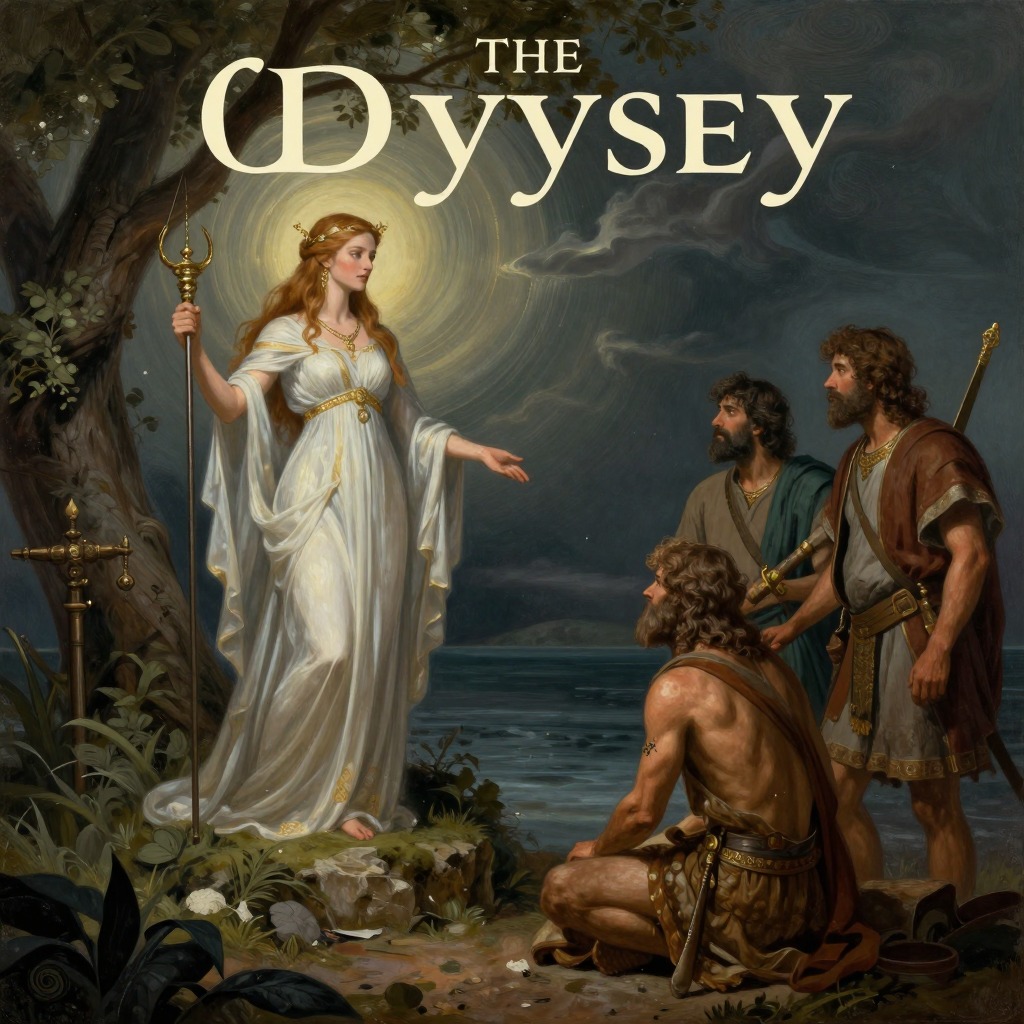
Hermes's most direct interaction with a mortal occurs when Odysseus is on his way to confront Circe. As Odysseus approaches the enchantress's house, Hermes meets him in the guise of a young man in the hey-day of his youth and beauty, with the down just coming upon his face. He takes Odysseus by the hand and warns him that his men are shut up in Circe's pigstyes. He gives Odysseus the herb moly, whose root is black and flower white as milk, telling him it will be a talisman against Circe's drugs. He instructs Odysseus exactly what to do: when Circe strikes him with her wand, he must draw his sword and spring upon her as though to kill her; she will then be frightened and desire him to go to bed with her, but he must make her swear a solemn oath that she will plot no further mischief. Hermes then returns to high Olympus, and Odysseus follows his instructions precisely, succeeding where his men had failed. This intervention is the turning point of the Circe episode, transforming a potential disaster into a year-long stay that yields crucial information about the journey ahead.
Role in the Underworld and Aftermath
Hermes's function as psychopomp is most vividly displayed in the final book of the Odyssey. After the suitors have been killed, Hermes summons their ghosts, holding his fair golden wand. He rouses them and leads them, whining and gibbering like bats in a cave, down through the dark abode of death. They pass the waters of Oceanus, the rock Leucas, and the gates of the sun, reaching the meadow of asphodel where the souls of the dead dwell. There they encounter the ghosts of Achilles, Patroclus, Antilochus, Ajax, and Agamemnon, and the ghost of Agamemnon recognizes Amphimedon and learns the full story of the suitors' destruction. This scene provides the poem's final commentary on the fate of the wicked and the justice of Odysseus's revenge.
Thematic Significance
Hermes embodies the principle of divine communication and the enforcement of cosmic order. He is the god who makes things happen by carrying messages that cannot be ignored. His warning to Aegisthus establishes that the gods give fair notice before punishment falls; his command to Calypso sets Odysseus free; his gift of moly to Odysseus ensures that Circe's power can be overcome. He is also the god who bridges the boundary between life and death, leading souls to the underworld and, in the case of Odysseus, providing the means to survive encounters with the supernatural. In a poem structured around journeys, disguises, and revelations, Hermes is the god of transitions—the one who moves between worlds, delivers the word that changes everything, and ensures that the will of Zeus is carried out.